
Heavy equipment jobs
How to Bleed a Hydraulic System or Cylinder
That’s every step. Mechy builds these steps for your machine from a photo, or just its make and model. First guide free. No sign-up, no card.
Build it for my machineMechy builds these steps for your machine from a photo, or just its make and model. First guide free. No sign-up, no card. Pricing
- 45 min
- Intermediate
- 9 steps
- 6 tools
- 2 parts
- About $130–$150 of shop labor you keep
Sample guide. A heavy-equipment mechanic hasn't reviewed this one yet, so search engines don't index it. Follow your machine's manual where they differ.
Short answer
To bleed a hydraulic system, fill the tank with the specified oil, check every fitting you touched, run at low idle, cycle each function slowly and then through full strokes without holding the end stop, bleed the cylinder screw only at low pressure, and recheck the level.
What the dealer bills vs what you buy
Dealer
$130–$150 labor
- About 45 min at $170–$200 an hour in their shop.
- If their truck comes out: $140–$155 for the same 45 min, plus $2.25–$6.50 a mile.
- Plus the same hydraulic oil and spare O-rings or seals for any fitting that weeps.
- And the machine sits until a bay or a truck is free.
You
Parts only and your time
- 1× Hydraulic oil, 1× Spare O-rings or seals for any fitting that weeps, from the parts list.
- About 45 min of your own time.
- Start when the machine is free, not when a bay opens.
- Specialist task: only if you’re trained for it.
Labor: the straight-time rates three equipment dealers bid on 2026 county repair contracts in Missouri and New York (Sources, at the end). Your dealer’s rate and the hours they book may differ, so ask for a quote. Part prices depend on the machine, so none are shown.
Safety first
Specialist task: trained techs onlyDo these before step 1.
- DANGERLock out: implements down, chocked, key out, isolator off, tag on.
- DANGERSupport it: level ground, rated stands or cribbing, not a jack.
- DANGERRelieve pressure: engine off, cycle controls, bleed accumulators.
- DANGERLeaks: never feel by hand. An injection injury needs the ER now.
- DANGERStored energy: OEM discharge steps for struts, springs, accumulators.
- WARNINGHeavy part (23 kg+): lifting gear or two people, mind pinch points.
Stop and call a pro or the dealer if
- Air or foam keeps returning after repeated cycling: suspect a suction leak, so stop and trace it.
- The pump stays noisy or cavitates after bleeding.
Mechy's guides help, but they don't replace the maker's manual, your training or your site's rules. If something doesn't match what you see, stop and check.
Tools
Tick what you have. In the app, Mechy ticks the ones it can see in your photos.
Parts and supplies
- 1×Hydraulic oilgrade and type as called for in the OEM manualCheck before you buy
- 1×Spare O-rings or seals for any fitting that weepsmatch the fittingCheck before you buy
Steps
-
Step 1 of 9
Lock out and relieve pressure
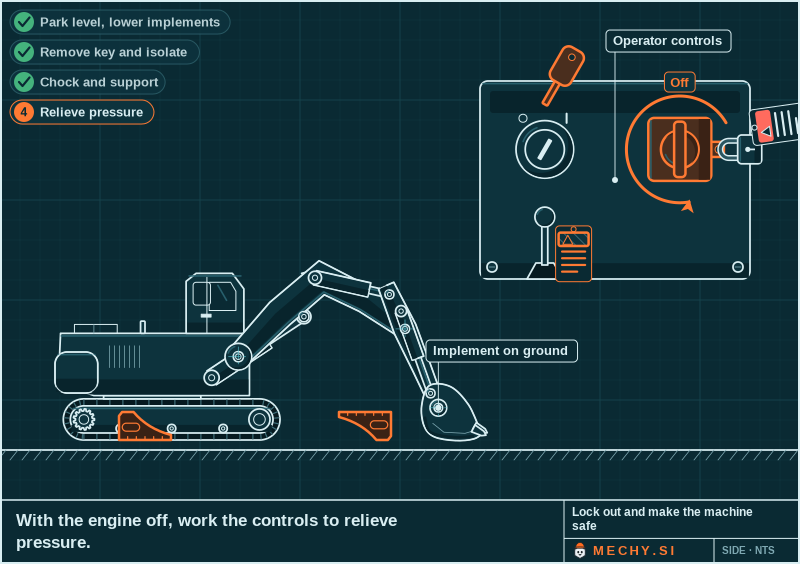
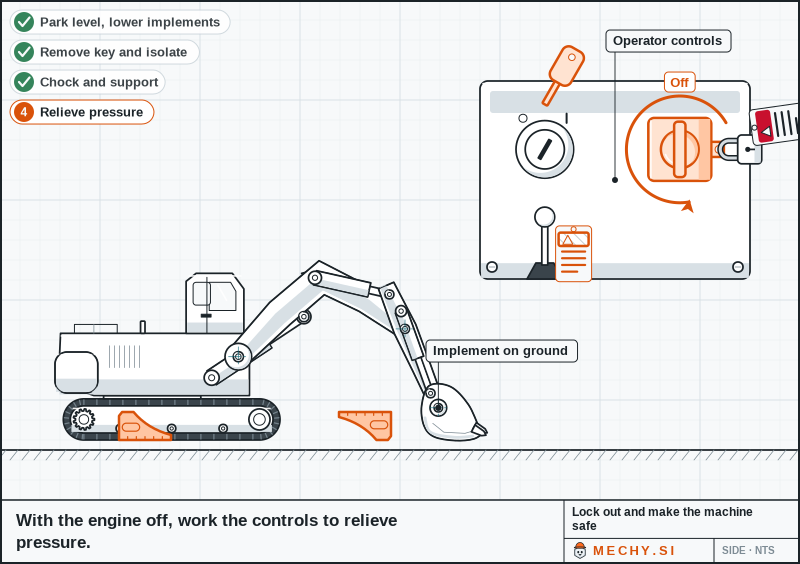
Park level, implements on the ground, engine off, key out, isolator off, tag on controls. Chock or crib anything raised. Work the controls with the engine off to relieve pressure, including any accumulator as the manual shows.
Cribbing and wheel chocks
-
Step 2 of 9
Check every fitting you touched
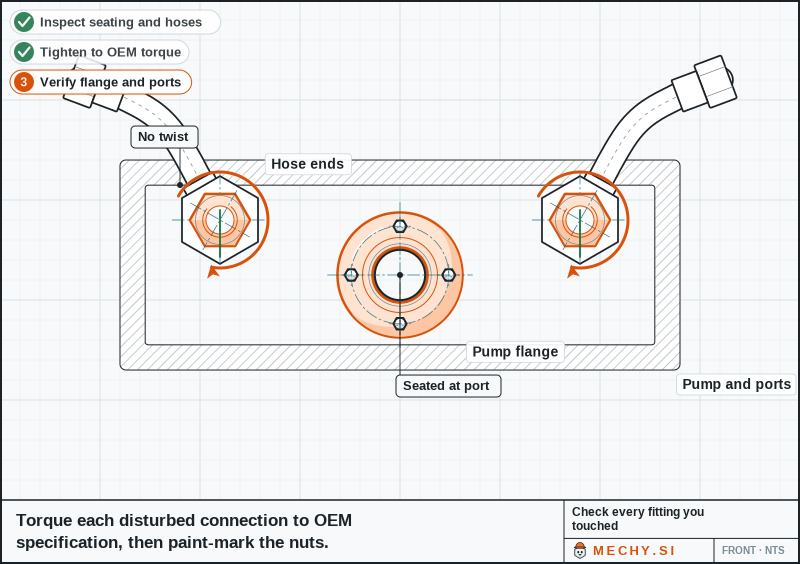
Confirm each hose end, pump flange and port you disturbed is clean, seated and tight with no twisted hose. Tighten to the torque in the manual, then paint-mark the nuts so movement shows later.
Torque: per OEM manual for each fitting Check it against your manual.
Wrench set for fittings
-
Step 3 of 9
Fill the tank to the mark
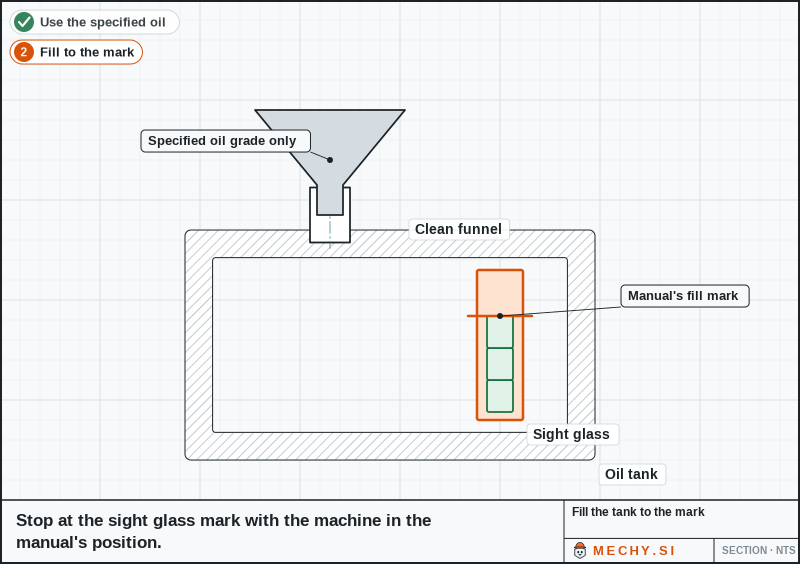
Fill through a clean funnel or fill pump with the oil the manual calls for, to the sight glass or dipstick mark in the manual's position. Never mix grades. Fill a new pump case with oil as the manual says before starting.
Clean funnel or fill pump
-
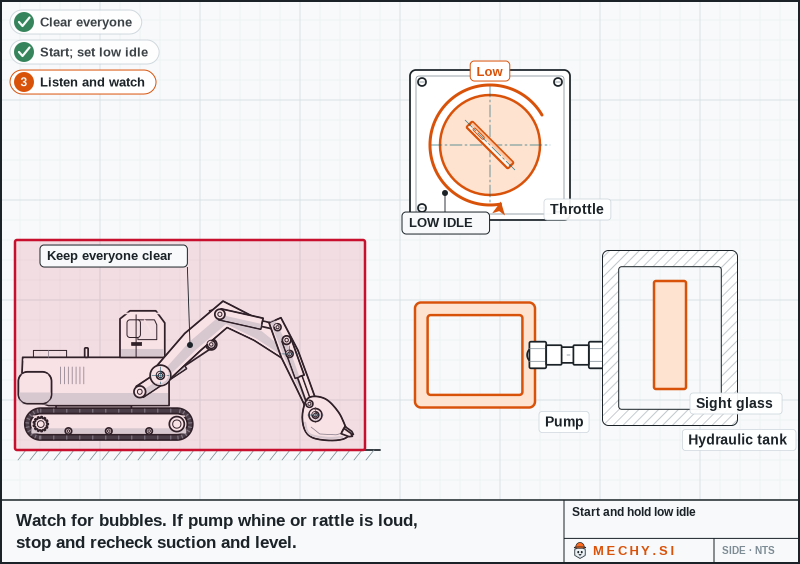
Step 4 of 9
Start and hold low idle
Check suction valves are open and the level is at the mark. Clear everyone from the machine. Remove your own lock and tag, start the engine and leave it at low idle. Listen at the pump; if whine or rattle is loud, stop and recheck suction and level.
Shut down at once on loud pump noise or a gushing leak.
-
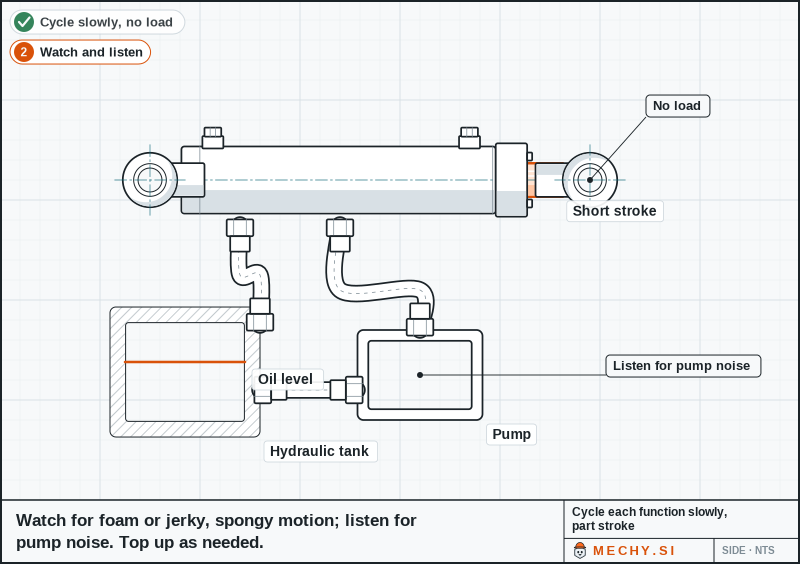
Step 5 of 9
Cycle each function slowly, part stroke
With the implement clear of the ground and of people, move each function slowly through part of its stroke, back and forth, with no load. Watch for foamy oil, jerky or spongy movement and pump noise. Top up whenever the level drops below the mark.
-
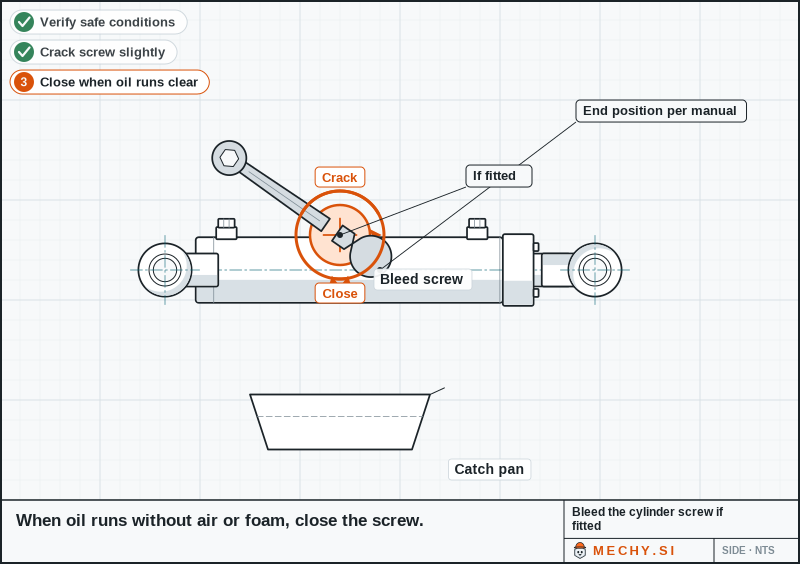
Step 6 of 9
Bleed the cylinder screw if fitted
Only at low pressure, with the cylinder at the end the manual states and no movement commanded, crack the bleed screw just enough for oil to weep. Close it when the oil runs without air or foam. Catch the oil in a pan.
Never open a bleed screw under load or high pressure.
Hex or wrench for bleed screw, Drain pan and rags
-
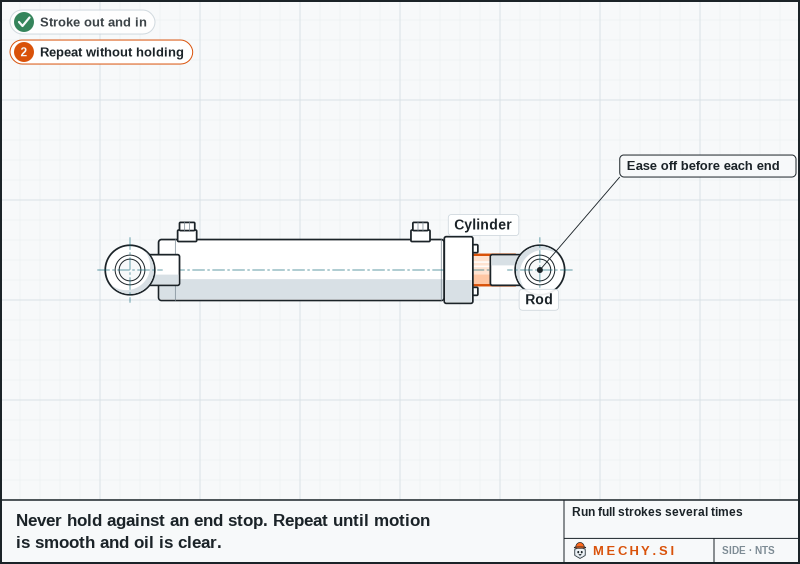
Step 7 of 9
Run full strokes several times
Run each function through full strokes several times, slowly, easing off before the end stop and never holding against it. Repeat until the movement is smooth and the oil in the sight glass is free of foam.
-
Step 8 of 9
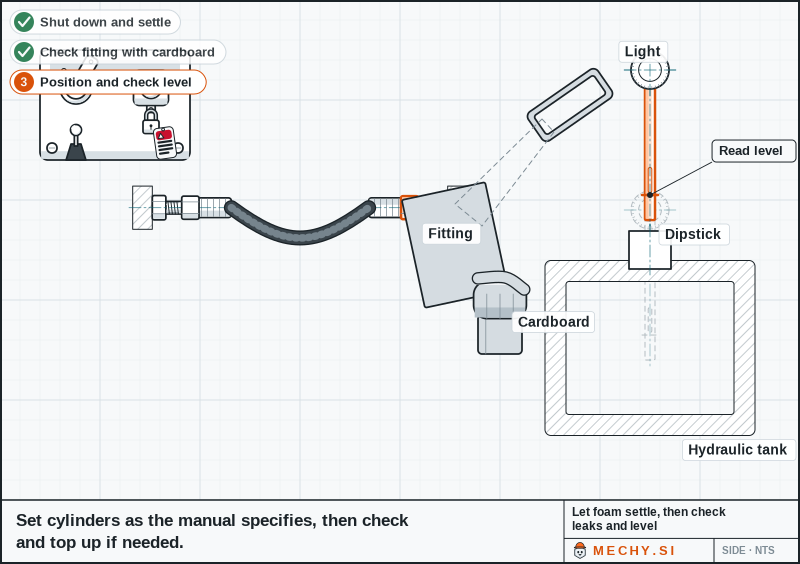
Settle the oil, check leaks and level
Shut down and let foamy oil settle. Check fittings with cardboard and a light, not your hand. Set the cylinders in the position the manual shows, then top up to the mark without overfilling.
Cardboard and flashlight
-
Step 9 of 9
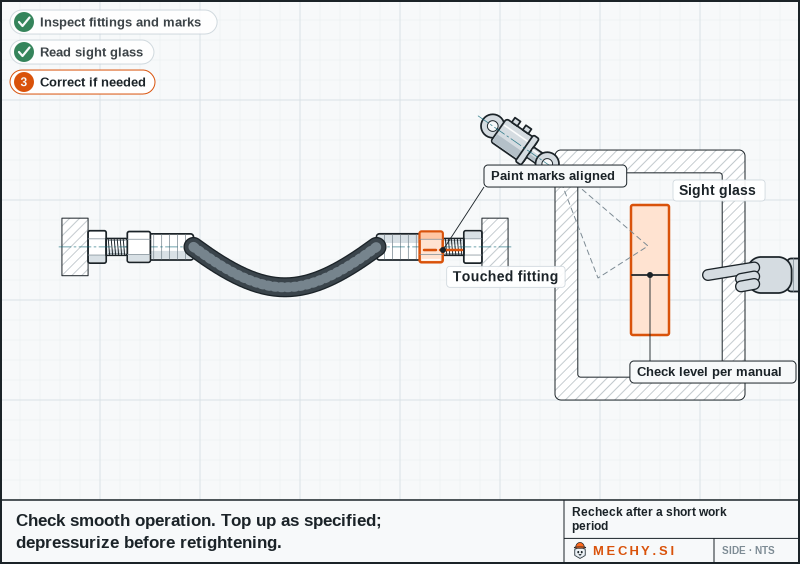
Recheck after a short work period
After the machine has worked under light load, recheck for leaks at every touched fitting, paint marks for movement, level and smooth operation. Top up and retighten if needed.


Common mistakes
- Starting the engine before filling the pump case and tank to the mark.
- Holding a function against the end stop, which overheats oil and loads the relief valve.
- Opening a bleed screw with pressure on or the implement raised.
- Feeling for leaks with a bare hand instead of cardboard.
- Ignoring foam that keeps returning, when it points to a suction leak.
Questions
How do you bleed a hydraulic system?
Fill the tank with the specified oil, check fittings, run at low idle, cycle each function slowly through part strokes, then full strokes without holding the end stop. Top up as the level drops, then recheck level.
How do you know there is air in a hydraulic system?
Foamy oil, spongy or jerky movement and pump whine or rattle. Milky or bubbly oil in the sight glass points to aeration.
Do all hydraulic cylinders have a bleed screw?
No. Many are bled by cycling alone. Use a bleed screw only if the cylinder has one, at low pressure and at the end of stroke the manual states.
Why does air keep coming back after bleeding?
Usually a suction-side leak, a loose fitting or a low oil level. Stop and trace it rather than cycling longer.
Can I run the pump dry to bleed it?
No. Fill the pump case and tank first, because a dry pump can be damaged within seconds.
Sources
- Taney County, MO: Mechanic Services bid award, Fabick Cat, shop $180 / field $199 an hour (July 2026)
- Erie County, NY: Trucks and Heavy Equipment Parts and Repairs contract, Five Star Equipment, labor $200 / field $205 an hour (April 2026)
- Boone County, MO: Mechanic Services bid tabulation 06-30JAN26, Martin Equipment, shop $170 / field $185 an hour (January 2026)
Updated · By Mechy (Winding AI, Inc.) · How we write these pages
Different machine? Build it for yours.
Mechy reads the machine from your photo, or its make and model, and builds the steps, tools and parts for it.
First guide free. No sign-up, no card.