
Heavy equipment jobs
How to Adjust Track Tension (Mini Excavator, Skid Steer)
That’s every step. Mechy builds these steps for your machine from a photo, or just its make and model.
Build it for my machineMechy builds these steps for your machine from a photo, or just its make and model. Pricing
- 45 min
- Easy
- 9 steps
- 9 tools
- 1 part
- About $130–$150 of shop labor you keep
Sample guide. A heavy-equipment mechanic hasn't reviewed this one yet, so search engines don't index it. Follow your machine's manual where they differ.
Short answer
Park level, raise and block one track, run it to clear mud, lock out, measure sag at mid-span against the manual, then pump grease in to tighten or open the grease valve one turn at most to loosen. Lower, cycle and re-check.
What the dealer bills vs what you buy
Dealer
$130–$150 labor
- About 45 min at $170–$200 an hour in their shop.
- If their truck comes out: $140–$155 for the same 45 min, plus $2.25–$6.50 a mile.
- Plus the same track grease.
- And the machine sits until a bay or a truck is free.
You
Parts only and your time
- 1× Track grease, from the parts list.
- About 45 min of your own time.
- Start when the machine is free, not when a bay opens.
- Specialist task: only if you’re trained for it.
Labor: the straight-time rates three equipment dealers bid on 2026 county repair contracts in Missouri and New York (Sources, at the end). Your dealer’s rate and the hours they book may differ, so ask for a quote. Part prices depend on the machine, so none are shown.
Safety first
Specialist task: trained techs onlyDo these before step 1.
- DANGERLock out: implements down, chocked, key out, isolator off, tag on.
- DANGERSupport it: level ground, rated stands or cribbing, not a jack.
- DANGERRelieve pressure: engine off, cycle controls, bleed accumulators.
- DANGERLeaks: never feel by hand. An injection injury needs the ER now.
- DANGERTrack adjuster: relief valve 1 turn max, never stand in front of it.
- WARNINGHeavy part (23 kg+): lifting gear or two people, mind pinch points.
Stop and call a pro or the dealer if
- The track will not tighten or loosen, or grease leaks from the adjuster body or seals (cylinder or seal failure).
- The track is cracked, has exposed or broken cords, or the sprocket, idler or rollers are badly worn.
Mechy's guides help, but they don't replace the maker's manual, your training or your site's rules. If something doesn't match what you see, stop and check.
Tools
Tick what you have. In the app, Mechy ticks the ones it can see in your photos.
Parts and supplies
- 1×Track greaseGrade per OEM manualCheck before you buy
Steps
-
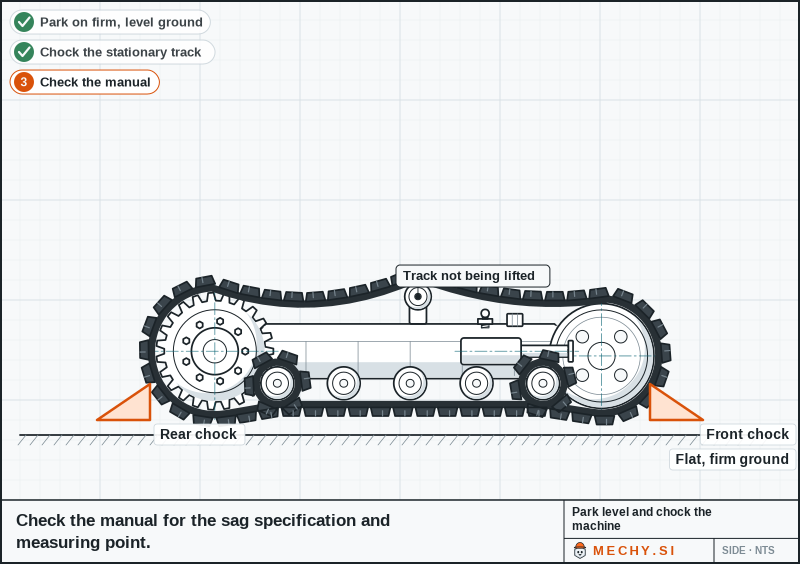
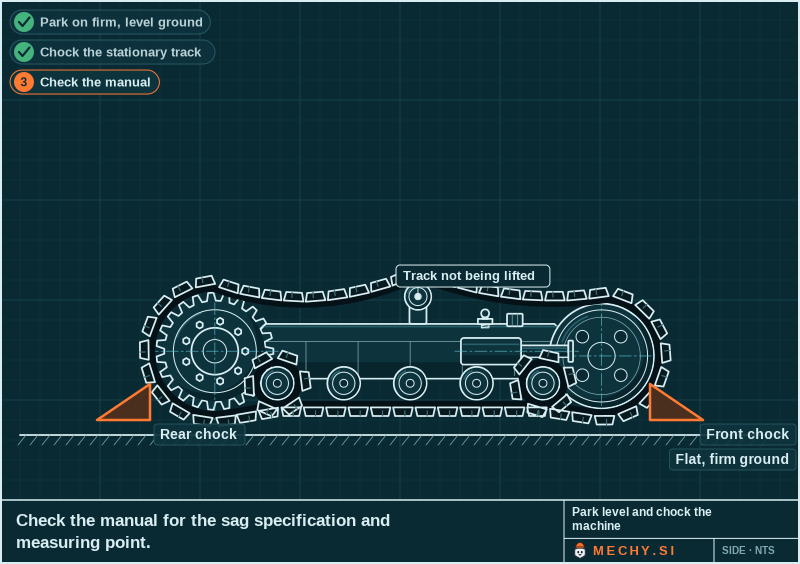
Step 1 of 9
Park level and chock the machine
Park on flat, firm ground. Chock the track you are not lifting. Look up the sag spec and measuring point in the manual before starting.
Track chocks or blocks
-
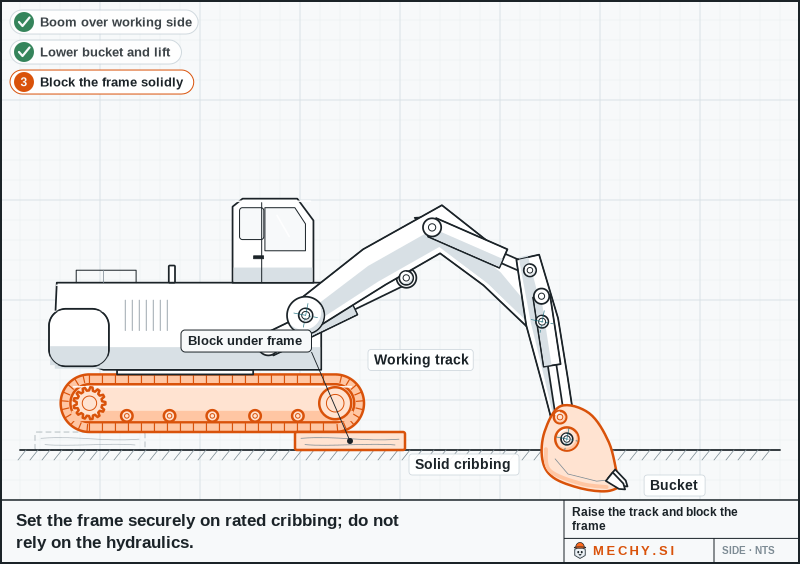
Step 2 of 9
Raise the track and block the frame
Excavator: swing the upper so the boom is over the working side, and use the boom to lift that track just clear of the ground. CTL: raise it and set it on rated stands. Block the frame solidly, then settle it on the blocks.
Never go under it held only by hydraulics. Stands or cribbing must carry the load.
Cribbing or rated jack stands
-
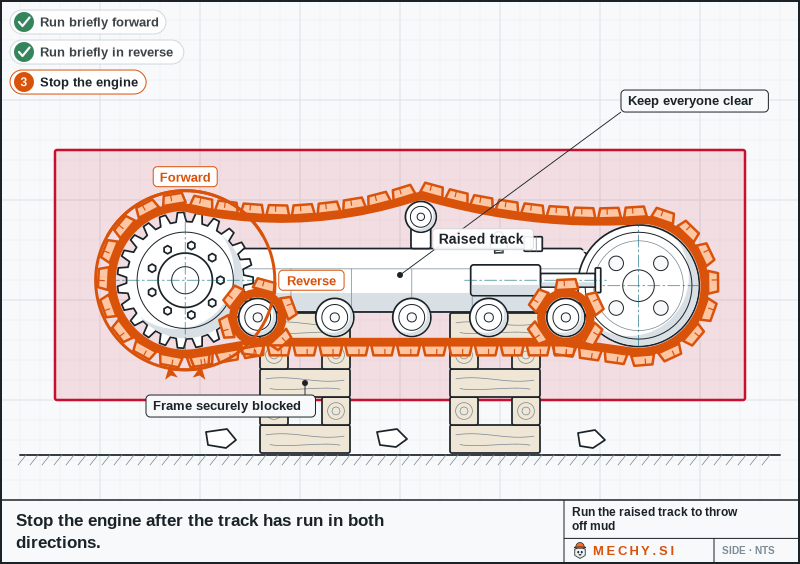
Step 3 of 9
Run the track to throw off mud
With the track blocked clear of the ground and everyone clear, run it briefly in both directions to throw off mud, then stop the engine. Keep hands, tools and body away from the turning track.
Never reach into a running track. Stop the engine before anything else.
-
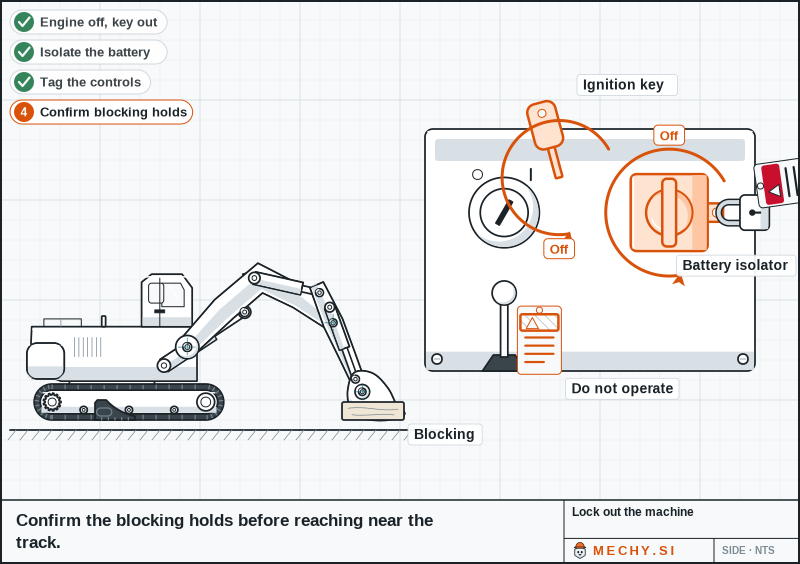
Step 4 of 9
Lock out the machine
Engine off, key out, battery isolator off, tag on the controls. Confirm the blocking holds before you reach near the track.
Lockout tag and lock
-
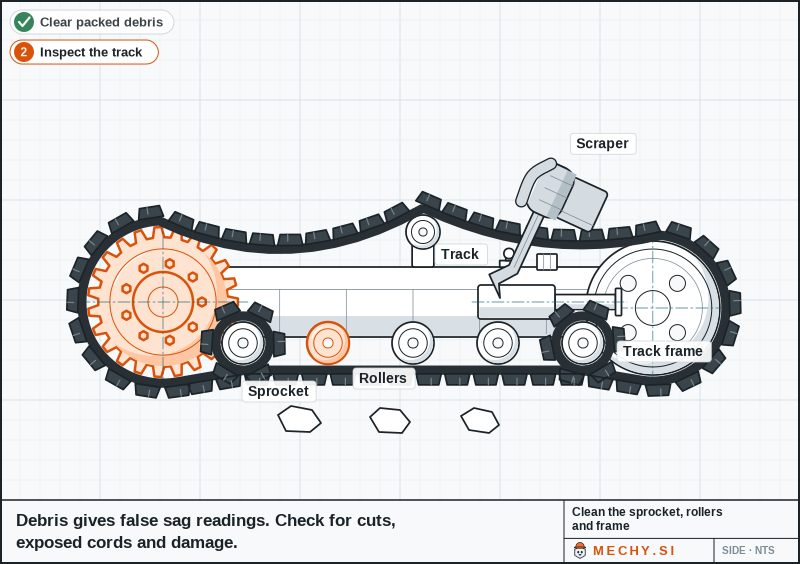
Step 5 of 9
Clean the sprocket, rollers and frame
Scrape or wash packed mud and rock from the sprocket, rollers and frame. Packed debris gives false sag readings. Look for cuts, exposed cords and damage.
Pressure washer or mud scraper
-
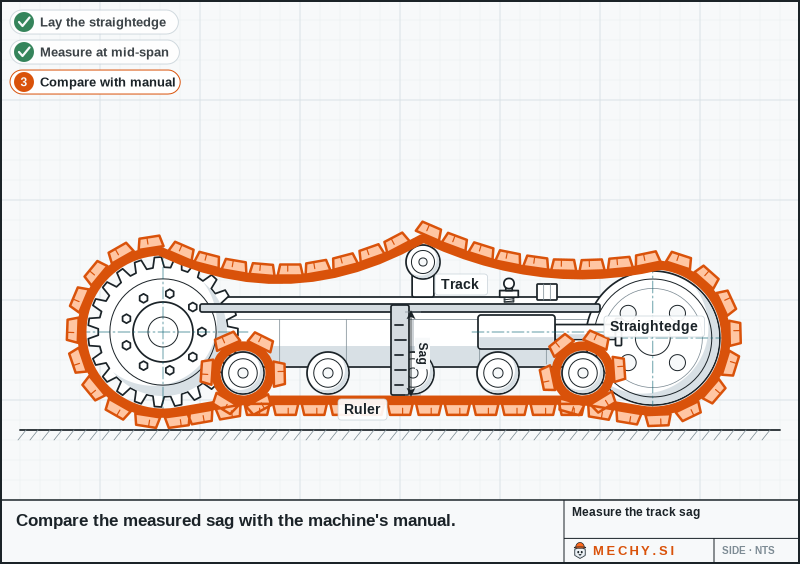
Step 6 of 9
Measure the sag
Lay the straightedge along the track frame or bottom roller. Measure the gap down to the track at the middle, at the point the manual gives. Compare it with the manual.
Track sag: Per your manual (spec and measuring point) Check it against your manual.
Straightedge, Tape measure or ruler
-
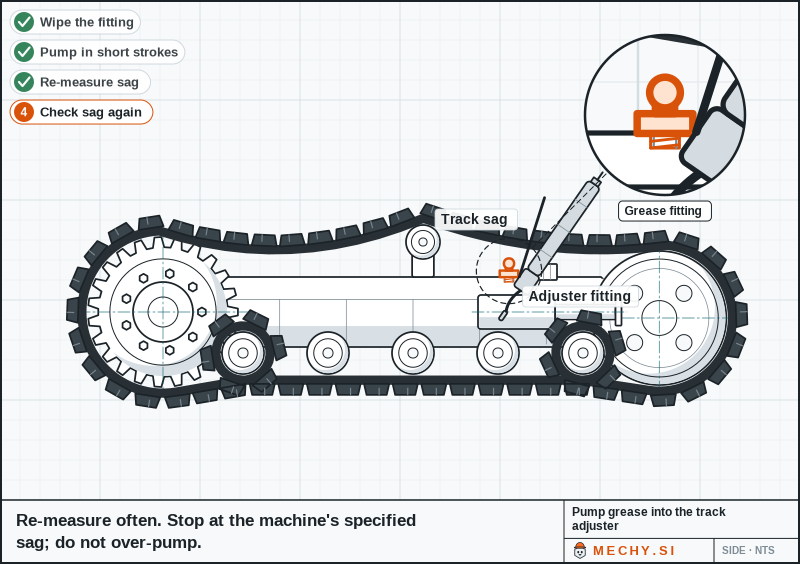
Step 7 of 9
Tighten: pump grease into the adjuster
Wipe the fitting, then pump the grease gun into the adjuster fitting in short strokes. Re-measure often until sag is within spec. Stop at spec; do not over-pump.
Grease gun
-
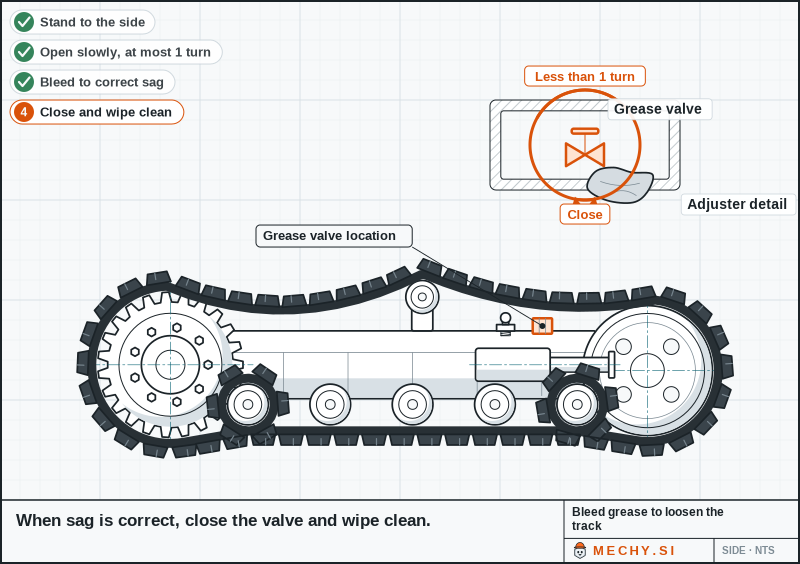
Step 8 of 9
Loosen: bleed grease at the grease valve
Stand to the side. Open the grease valve slowly, one turn at most, and let grease out until sag is in spec, then close it and wipe clean. If the track does not slacken, close the valve and stop.
Never remove the grease valve or the fitting. Never open past one turn. Pressure can eject them.
Wrench for grease valve, Rags and cardboard
-
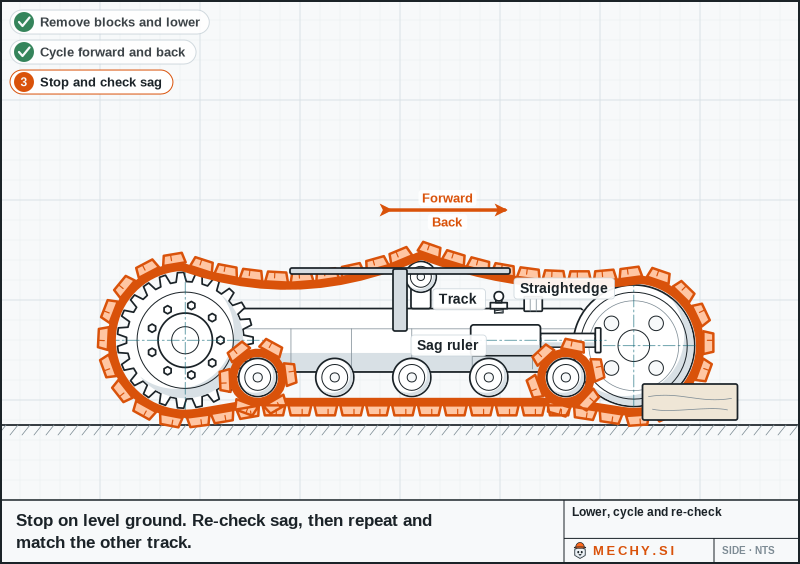
Step 9 of 9
Lower, cycle and re-check
Clear people and tools, remove the lockout, start the engine and lift the frame just off the blocking. Pull the blocks and lower it. Run forward and back several meters, stop on level ground, re-check sag and look for grease leaks at the adjuster. Match the other track. Re-check after a short working period.
Tape measure or ruler


Common mistakes
- Measuring sag with mud packed in the frame, which gives a false reading.
- Working under a track held up only by the boom or hydraulics.
- Removing the grease valve or fitting instead of just opening it, risking grease injection.
- Over-pumping grease so the track is far too tight.
- Not re-checking sag after lowering and running the machine.
Questions
How tight should a mini excavator track be?
Tight enough that the sag at mid-span matches the manual's spec and measuring point. Specs differ by machine and track, so use your OEM manual rather than a general figure.
How do I tighten a mini excavator track?
Raise and block the track, clean it, measure the sag, then pump grease into the adjuster fitting in short strokes, re-measuring until it is in spec.
How do I loosen a track safely?
Stand to the side and open the grease valve slowly, no more than one turn. Never remove the valve or fitting; the grease is under very high pressure.
What happens if the track is too loose?
It can wander and come off the sprocket or idler, and the lugs and guides wear faster.
Why is a too-tight track bad?
It overloads the sprocket, idler, rollers and bearings and can stretch the steel cords, so the undercarriage wears fast.
Sources
- Taney County, MO: Mechanic Services bid award, Fabick Cat, shop $180 / field $199 an hour (July 2026)
- Erie County, NY: Trucks and Heavy Equipment Parts and Repairs contract, Five Star Equipment, labor $200 / field $205 an hour (April 2026)
- Boone County, MO: Mechanic Services bid tabulation 06-30JAN26, Martin Equipment, shop $170 / field $185 an hour (January 2026)
Updated · By Mechy (Winding AI, Inc.) · How we write these pages
Different machine? Build it for yours.
Mechy reads the machine from your photo, or its make and model, and builds the steps, tools and parts for it.